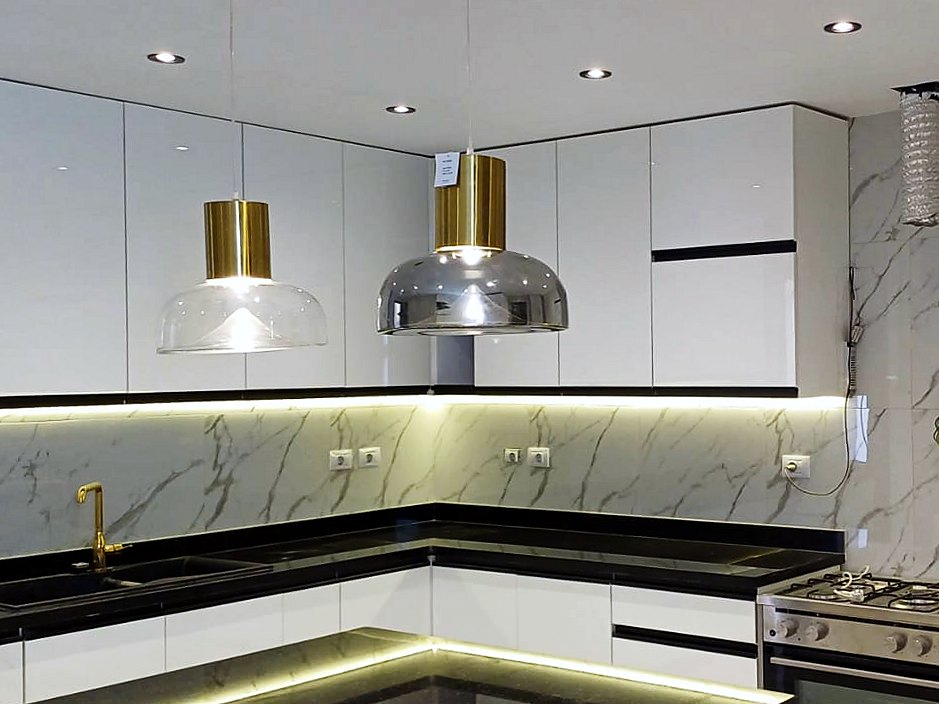
Guides · materials
Kitchen materials compared
A kitchen is a box, a door, a worktop and the hardware that moves them, and each needs its own decision. Here is what HPL, acrylic, poly-lac, wood and aluminium are really like, and what to check before you choose.
The carcass comes before the door
The carcass, the cabinet box behind the doors, decides how long a kitchen lasts, because it is what sits in the moisture around the sink and the dishwasher.
- Moisture-resistant MDF: a dense, stable board made for humid places, and the usual sound choice for carcasses.
- Plywood: layers of veneer glued crosswise, strong and good at holding screws. Marine grades are made for wet conditions.
- Standard particleboard or plain MDF: acceptable in dry cabinets, but it swells if water reaches an unsealed edge.
- Aluminium carcasses: they do not swell or rot, which suits very humid and coastal kitchens, though the look is more utilitarian.
Whatever the board, every edge should be sealed with edge banding, especially inside the sink cabinet, and that cabinet benefits from a protective liner. Ask what the carcass is made of before you discuss door colours.
Door fronts compared
The front is what you see and touch every day, and each material trades looks against toughness.
| Front | What it is | Strengths | Weak points | Suits |
|---|---|---|---|---|
| HPL | A high-pressure laminate sheet bonded to a board | Tough against scratches, knocks and heat; many matt and wood finishes | Flat doors only; the edges are the weak point if badly sealed; hard to repair invisibly | Busy family kitchens and rental units |
| Acrylic | A high-gloss acrylic sheet bonded to MDF | Deep mirror gloss; easy to wipe | Fine scratches show on the gloss; limited stock colours; hard to repair locally | Modern kitchens with careful use |
| Poly-lac (lacquer) | Polyurethane paint sprayed in coats on MDF and cured | Any colour, matt or gloss; profiled classic doors possible; repairable | Can chip on impact; quality depends heavily on the spray shop | Classic, neo-classic and custom colours |
| Natural wood | Solid timber, or real wood veneer on a board | Warm, natural grain that ages well; can be refinished | Solid wood moves with humidity and needs care of its varnish | Classic kitchens in dry, ventilated homes |
| Aluminium | Aluminium frames with panel or glass infills | Does not swell or rot; copes with humidity | A less warm look; the panels and fittings set the quality | Very humid flats, utility areas, some chalets |
HPL kitchens: the pros and cons
HPL is one of the most searched-for kitchen materials in Egypt because it is tough and practical, but it has limits worth knowing before you choose it.
- Pro: the surface stands up well to scratches, knocks and everyday heat, and it is easy to clean.
- Pro: a wide choice of matt colours, textures and wood looks that stay consistent from door to door.
- Con: it comes as flat sheets, so profiled or curved classic doors are not possible.
- Con: the edges are the weak point. Poor banding lets water reach the board underneath, which then swells.
- Con: a deep scratch or chip cannot be touched up invisibly, and the door is usually replaced.
- Check: HPL is a surface, not the whole door. Ask what board is under it and how the edges are finished.
The worktop: granite, quartz or marble
The worktop takes more punishment than any other surface in the home, so choose it for how you cook, not only for its colour.
- Granite: a very hard natural stone that copes with heat and scratches and resists most stains, sealed where the stone needs it. Egyptian granites come in a wide range of colours.
- Quartz: an engineered stone of crushed quartz bound with resin. Even colour, non-porous and easy to clean, but put hot pans on a trivet, because the resin can mark under direct heat, and keep it out of strong direct sun.
- Marble: beautiful and cool to the touch, but lemon, vinegar and tomato etch the polish and oils can stain. Choose it only if you are happy for it to show its use.
The worktop is templated after the cabinets are fixed in place, so it fits the real room, not the drawing. Our guide to marble, granite and quartz compares the three in more detail.
Hardware: the part you feel every day
Hinges, runners and lift systems decide how a kitchen feels in daily use more than the door material does.
- Soft-close hinges with three-way adjustment, so doors can be realigned after the kitchen settles.
- Full-extension drawer runners rated for the load: pans and plates are heavy, and weak runners are the first thing to sag.
- Lift systems for wall cabinets that open upwards, sized to the weight of the door.
- Adjustable legs behind the plinth, so the kitchen can be levelled on an uneven floor and the plinth removed for cleaning.
- Near the sea, hardware with a finish made for coastal air, because salt corrodes ordinary steel fittings.
- Handles or a handleless profile, chosen early, because they change the door design and the drawings.
Rather than asking for a brand name, ask for the load rating, the type of adjustment and whether replacement parts are easy to get.
Open kitchens and chalet kitchens
Where the kitchen is changes what it has to survive.
- Open kitchen: cooking fumes and grease reach the living room, so an extractor ducted to the outside matters more than the door finish. Matt fronts hide fingerprints better than gloss in a room everyone looks at.
- Open kitchen: plan the worktop joints, the splashback and the appliance positions with the whole living space in view.
- Chalet: salt air, humidity and months of closed rooms. Choose moisture-hardened carcasses, sealed edges and marine-grade hardware, and avoid solid timber fronts.
- Chalet: when you close it for the season, leave the cabinet doors ajar or ventilate the space, and shut the water off at the main valve.
- Humid Alexandria flats: aluminium, HPL on moisture-resistant board and acrylic all cope well if the edges are sealed; solid wood is the most sensitive.
The order of decisions
A kitchen goes smoothly when the decisions are made in this order.
Layout
Where the sink, hob, fridge and oven go, which sets the water, drainage, gas and electrical points.
Appliances
The exact models, before anything is cut, because cut-outs and cabinet sizes depend on them.
Carcass and fronts
The board, the door material and colour, and the handles or handleless profile.
Worktop
The stone or quartz, chosen together with the fronts so the colours work as a set.
Hardware
Hinges, runners, lift systems and internal fittings, chosen by load and use.
Templating and fitting
The cabinets are fixed and levelled first; then the worktop is templated, cut and fitted.
How Itmam makes kitchens
Kitchens are made in our own workshops, and stone tops are templated, cut and installed by the same team, so the cabinets and the worktop come from one set of measurements.
We visit, measure and give you a written, itemised quotation before work starts, so you can see the carcass, the fronts, the worktop and the hardware item by item. You can also visit our showroom in El Deresa, Alexandria.
On a finishing contract you pay each supplier directly, the tax invoice is in your name, and our fee for supervision and execution is agreed in writing. We work in Alexandria, on the North Coast and in New Cairo.
Departments for this
Kitchens
A kitchen is the one room where bad manufacturing shows up daily — a door that drops, a drawer that catches, a worktop joint over the sink.
See moreQuartz & Sintered Stone
Engineered surfaces exist for one reason: predictability.
See more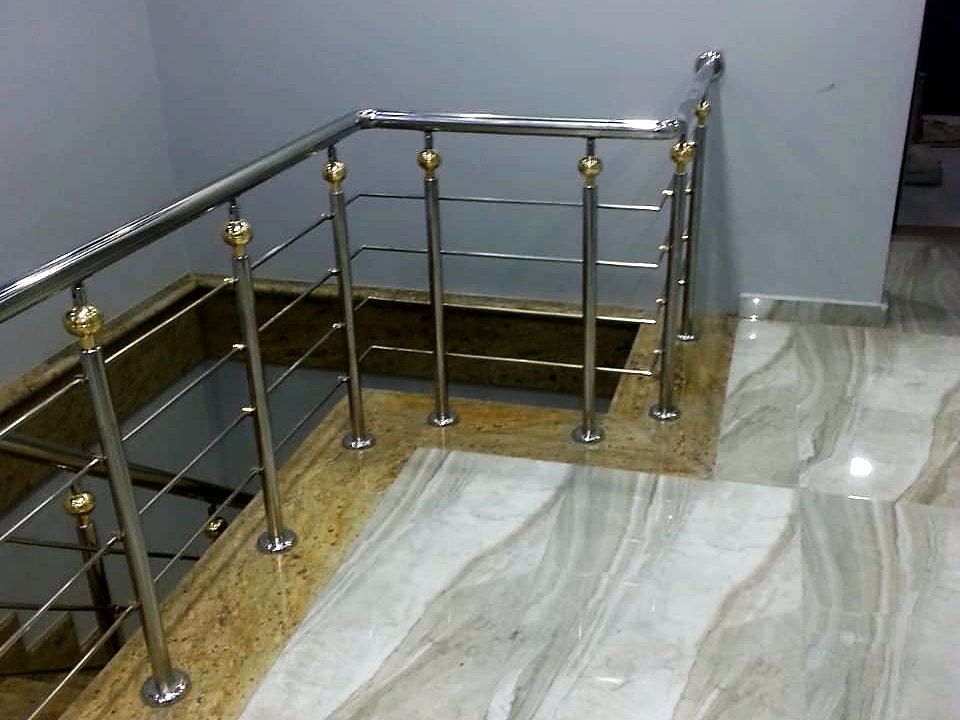
Granite
Granite is the stone you specify when a surface has to survive people.
See more
Questions people ask
HPL or acrylic: which is better?
Does acrylic scratch?
Aluminium or wooden kitchen?
Which kitchen material copes best with humidity?
Choose the worktop first, or the cabinets?
What is a poly-lac kitchen?
Read next
Marble, granite or quartz?
All three look beautiful on the first day. The difference shows years later, in a kitchen with lemons, on a stair with sand on…
See more Guides · MaterialsFinishing by the sea: what lasts and what fails
A finish that lasts for years in Cairo can fail within a few seasons on the North Coast. Salt, humidity, sun, sand and long…
See more