Supply · Quantity calculator
How many bricks, bags of cement and m³ of sand do you need?
Bricks, cement and sand are worked out from the area of the work, its thickness and the mix in the specification, not guessed. Enter your sizes in the calculator below, for brick walls, plaster or a tile mortar bed, to get the number of bricks, the m³ of sand and the bags of cement, as an estimate until the quantities are checked against the drawings and site measurements.
How brick, cement and sand quantities are worked out
There are three steps, and they are the same whether you are working out cement and sand for brickwork, for plaster or for laying tiles:
- The area of the work: the walls for brickwork, less doors and windows; the walls and ceilings for plaster; the floor for a tile bed.
- The volume of mortar: for brickwork, the wall’s volume less the bricks’ volume; for plaster and a tile bed, the area × the thickness, plus waste.
- The materials: sand is taken as roughly the mortar volume, and cement = sand in m³ × the mix in kg, divided by 50 kg for the number of bags.
Every figure on this page is an estimate using common sizes and mixes. The final quantities come from the drawings, site measurements and your engineer’s instructions, and the right mix is the one written in your project’s specification.
Work out your bricks, cement and sand
Choose the type of work. In ‘Brick walls’, enter the total wall length and the wall height in metres, the area of doors and windows to take off in m², and the wall thickness: half brick (12 cm) or one brick (25 cm). In ‘Plaster’, enter the area of walls and ceilings and the plaster thickness (it starts at 2.5 cm). In ‘Tile mortar bed’, enter the floor area and the bed thickness (it starts at 3 cm). In all three you can change the cement per m³ of sand: it starts at 250 kg for brickwork and 300 kg for plaster and tile beds.
Enter the measurements first.
Rough quantities
| Item | Rough quantity |
|---|
A first estimate using common sizes, waste included. Final quantities come from the drawings, site measurements and your engineer; steel and concrete come from the structural drawings.
You get the mortar and sand in m³ and the cement in kg and in 50 kg bags, and for brickwork the wall area and the number of bricks as well. The figures include waste and are estimates; the final quantities come from the drawings, site measurements and your engineer. If you want to buy, send these quantities with the button and you get a written quotation for the supply.
How many bricks per m² of wall?
The calculator assumes the common red brick of 25 × 12 × 6 cm with mortar joints of about 1 cm. Each brick’s face in the wall, with its joint, is 26 × 7 cm, so one m² takes 1 ÷ (0.26 × 0.07) = about 54.95 bricks: about 55 in a half-brick wall, and twice that in a one-brick wall, which is two bricks thick with a joint between them. Then 5% is added for breakage and cutting.
Brick sizes vary from one factory to another, so measure your brick before you count, because a different size changes the figures.
| Wall | Thickness | Bricks per m² before waste | Mortar per m² with waste |
|---|---|---|---|
| Half brick | 12 cm | About 55 | About 0.025 m³ |
| One brick | 25 cm | About 110 | About 0.063 m³ |
The right thickness for each wall is in the architectural drawings.
Example: a half-brick wall 10 m long and 3 m high
Half-brick walls with a total length of 10 m and a height of 3 m, with a door and a window of 2 m² between them, and a mix of 250 kg of cement per m³ of sand:
Wall area
10 × 3 = 30 m², less 2 m² of openings = 28 m².
Bricks
28 × 54.95 = about 1,539 bricks, and with 5% waste about 1,616 bricks.
Mortar
The wall’s volume is 28 × 0.12 = 3.36 m³, and the bricks’ volume is 1,539 × 0.0018 m³ (one brick) = about 2.77 m³. The difference is about 0.59 m³, and with 20% waste about 0.71 m³.
Sand
About 0.71 m³, roughly the mortar volume.
Cement
0.71 × 250 = about 177 kg, or about 3.5 bags, rounded up: 4 bags.
The same walls one brick thick need about 3,231 bricks, about 1.75 m³ of mortar and the same of sand, and about 438 kg of cement, or 9 bags at the same mix.
Cement and sand for plaster
Plaster is usually built up in coats: a thin spatter coat with a richer cement mix so the next coat holds, then a base coat trued up to plaster dots and screeds, then a smooth finish coat. The calculator works on the total thickness with a single mix, so it is an overall estimate for all the coats together.
Mortar = area × thickness × 1.15, the extra covering uneven walls and waste. A common thickness is about 2 to 2.5 cm, and a common mix is 300 to 350 kg of cement per m³ of sand; the reference is your project’s specification and your engineer. Example: 100 m² of walls and ceilings at 2.5 cm with a 300 kg mix:
Mortar
100 × 0.025 = 2.5 m³, and with 15% extra = 2.875, about 2.9 m³.
Sand
About 2.9 m³.
Cement
2.875 × 300 = about 863 kg, or 17.25 bags, rounded up: 18 bags.
With a 350 kg mix the cement comes to about 1,006 kg, or 21 bags. If you do not have the wall area, the finishing-cost-by-size guide explains how to estimate it from the floor area.
Cement and sand for a tile mortar bed
Tiles laid on mortar need a mortar bed beneath them. Mortar = area × bed thickness × 1.10; a common thickness is about 3 cm and a common mix about 300 kg of cement per m³ of sand. Example: a 4 × 5 m room with a 3 cm bed:
- Mortar: 20 × 0.03 = 0.6 m³, and with 10% extra = 0.66 m³.
- Sand: about 0.66 m³.
- Cement: 0.66 × 300 = 198 kg, about 4 bags.
If your engineer calls for a levelling layer of sand under the mortar, work it out on its own: area × its thickness. Much porcelain today is laid with tile adhesive instead of mortar; adhesive is bought by the bag according to the coverage the maker prints on it, so it is not worked out here. The tiles themselves are in the tile calculator.
What the calculator does not work out
Steel and concrete are not worked out by a website calculator. The structural quantities, for slabs, columns and footings, come from the structural engineer’s drawings and reinforcement details, because they depend on the loads, the soil and the design of each element, so we give no figures for steel or concrete here. Before you order, check these points:
- Brick size: cement blocks, lightweight blocks and sizes other than 25 × 12 × 6 cm give different counts.
- Mix: 250 to 300 kg of cement per m³ of sand is common for brickwork mortar, and 300 to 350 for plaster, but the reference is your project’s specification. Change the figure in the calculator to match it.
- Thickness: a wall that leans or is uneven needs thicker plaster, so enter the actual thickness, not the usual one.
- Sand: sand for mortar should be clean, with no clay or debris in it, and it is ordered by the m³.
- Cement: store the bags somewhere dry and covered, off the ground, because damp spoils them, and order in batches if storage is limited.
Send us the quantities: cement, sand and brick supply
If your quantities are ready, supply-only is available: send the calculator’s result or the quantities from your BOQ or drawings, with the type and size of brick, the type of cement and sand, and where the site is, and you get a written quotation for exactly what you sent.
On a finishing or building contract we check the quantities against the drawings and site measurements and write them into the quotation line by line. You pay each supplier directly, with the tax invoice in your name, and our fee for supervision and execution is agreed in writing before work starts. We work in Alexandria, the North Coast and New Cairo / Fifth Settlement.
Departments for this
Blocks & Bricks
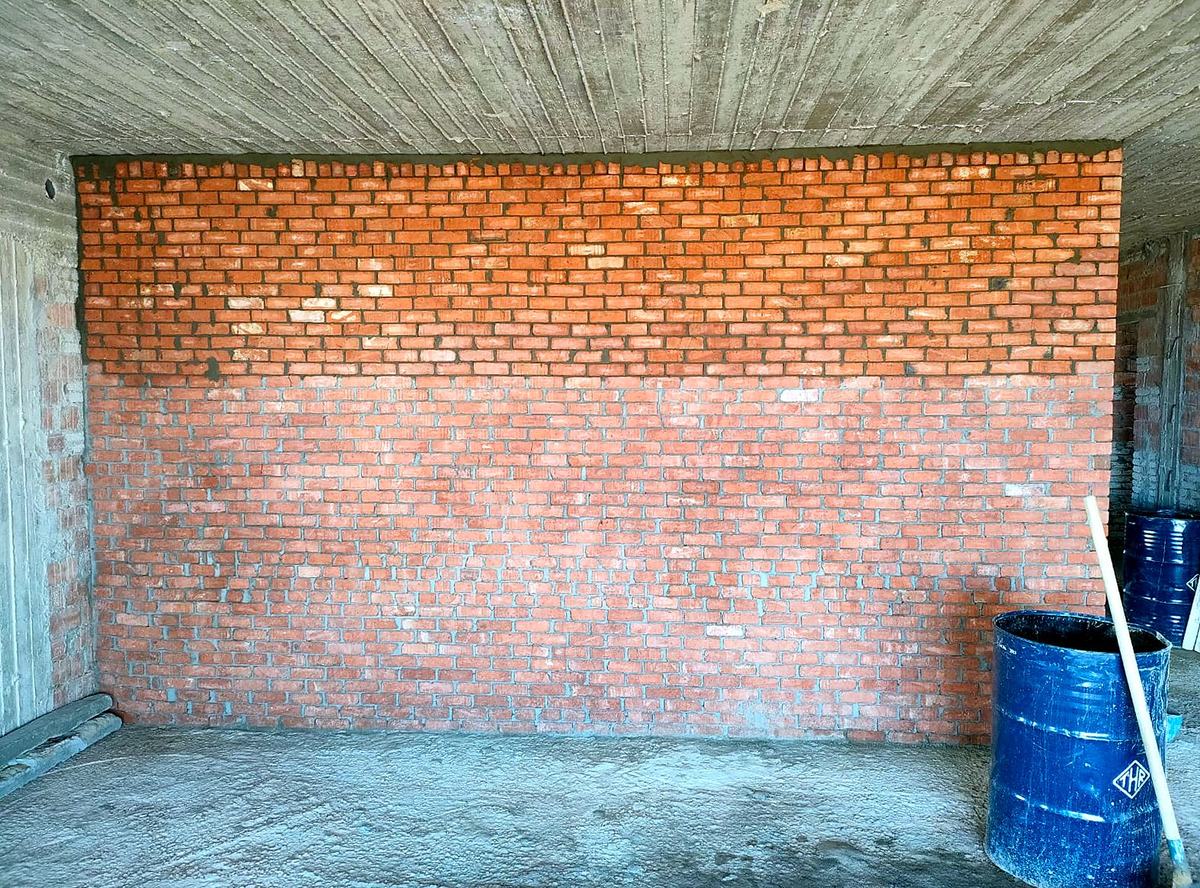
Blocks and bricks go out by the pallet, the thousand or the lorry load to whoever is building, with no requirement that we lay a single one.
See more
Cement
You can buy cement from us by the bag, by the pallet or by the bulk tanker without hiring us to build anything.
See more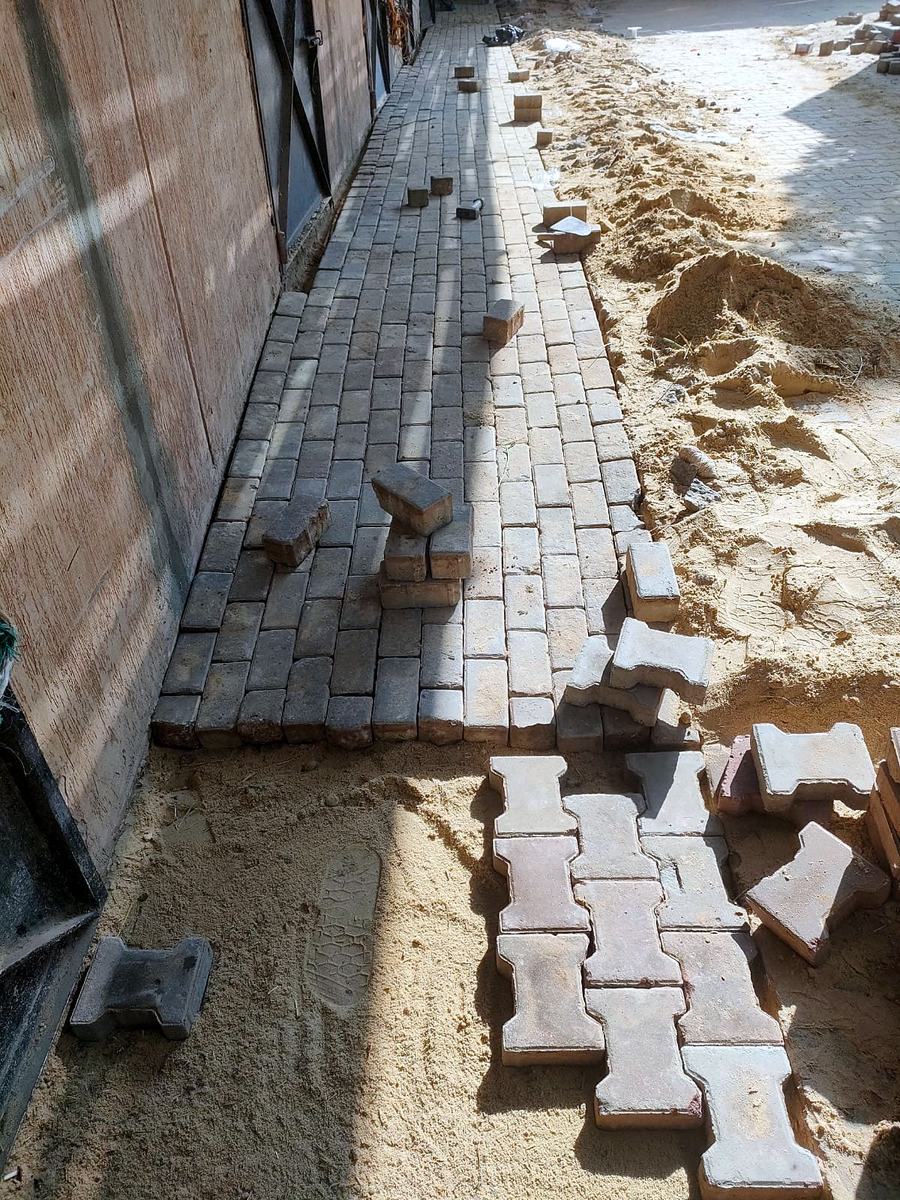
Sand, Gravel & Aggregate
Sand and aggregate are sold by the cubic metre and by the lorry load, tipped where you want them on site, with nobody from us staying behind to mix anything.
See moreQuestions people ask
How many bricks in one m² of half-brick wall?
How many bricks in one m³ of brickwork?
How many m² of plaster does one bag of cement cover?
How much sand do I need for plaster?
How do I order these quantities from you?
Read next
Finishing cost by flat size: what scales and what doesn’t
‘How much to finish a 100 m² flat?’ has no honest answer until someone has seen the flat. This page gives you something more…
See more Guides · Before you startThe finishing BOQ: every line that should be written down
A muqaysa, or bill of quantities, lists every job and material in your finish with its unit and specification. Read properly, it…
See more Finishing · by current stateFrom red brick to keys
Took handover of a unit in red brick? Then everything is still ahead of you, and this is the best moment to make the decisions…
See more Finishing · by propertyBuilding finishing, from lobby to roof
Finishing a building is not finishing one flat multiplied by the number of floors. There are shared areas every resident uses…
See more Guides · Quantity calculatorHow much tile do you need? Work out m², tiles and cartons
The tile you buy is not the room’s area: there is wastage for cuts and breakage, and tile is sold by the carton, not the metre.…
See more