Trade supply
Steel & Rebar
Reinforcement steel leaves our yard by the tonne, cut and bent to your own bar bending schedule if you want it, with no obligation to let us pour a single column. Homeowners building on their own plot, small contractors loading out a floor and engineers ordering against a drawing all buy on the same trade terms, delivered to site. We do not publish a rate, because steel is repriced constantly and a stale number helps nobody — send the schedule or the tonnage and you get a live quotation the same day.
Scope of works
What we actually do.
Everything below happens inside our business — no subcontracted links in the chain.
- 01
Deformed high-tensile bar
Ribbed reinforcement in the diameters Egyptian drawings actually call up — 10, 12, 16, 18, 22 and 25 mm — in standard 12 metre lengths, bundled and tagged by diameter. Supplied against the grade written on your drawing rather than whatever happens to be nearest the gate.
- 02
Mild steel round bar & mesh
Plain round mild steel in the small diameters for ties, links, light fabrication and starter bars, plus welded mesh in sheets and rolls for slabs on grade, screeds, retaining walls and pool shells where a mesh is faster and flatter than loose bar.
- 03
Cut and bent to schedule
Send the bar bending schedule and the steel arrives cut, bent, bundled and labelled by mark number — stirrups, links, L-bars, U-bars, cranked bars and spirals. It removes the offcut waste you would otherwise pay for, it removes a bench and two men from your site, and the fixers can start on the day of delivery instead of the day after.
- 04
Structural sections
I-beams and joists, parallel-flange channels, equal and unequal angle, flat bar, plate, and rectangular and square hollow section. For mezzanines, pergola frames, lintels, canopy structures, tank stands and plant platforms — sold cut to length or in stock lengths, whichever suits your fabricator.
- 05
Black & galvanised pipe
Welded steel pipe in the standard nominal bores and wall thicknesses, plain black for structural and mechanical use, hot-dip galvanised where it is going outside or carrying water. Threaded and socketed to order.
Specification
The numbers, before you ask.
| Deformed bar | Ribbed high-tensile at 10, 12, 16, 18, 22 and 25 mm, 12 m standard |
|---|---|
| Plain round bar | Mild steel in the small diameters for links, ties and light work |
| Weight check | Kilograms per metre is diameter squared over 162 — a 16 mm bar is 1.58 |
| Mesh | Welded fabric in sheets and rolls across the common gauges and pitches |
| Sections | I-beam, channel, equal and unequal angle, flat, plate, RHS and SHS |
| Pipe | Welded black and hot-dip galvanised, standard bores and wall thicknesses |
Selection
What we load out
Deformed reinforcement barBy the tonne
The ribbed high-tensile bar that goes into every frame in the country, in the six diameters that cover almost all residential and light commercial work. Bundled by diameter and tagged, so a mixed load can still be checked off the lorry.
Stirrups & links, cut and bentTo your schedule
Cut and bent to the bar bending schedule and delivered labelled by mark. This is where the money is saved on a small site — no bench, no bender, no offcut pile, and no argument about who cut the 18 mm short.
Welded meshSlabs & screeds
Sheets and rolls for ground-bearing slabs, screeds, blinding, retaining walls and pool shells. Faster to place than loose bar and it holds its spacing, provided somebody actually uses chairs and does not stand on it.
Structural sectionsFabrication
Beams, channels, angle, flat, plate and hollow section for mezzanines, pergolas, canopies, tank stands and lintels. Stock length or cut to your list.
Black & galvanised pipeStructural & services
Plain black for frames, props and mechanical work, galvanised where weather or water is involved. Galvanising is worth paying for on anything within reach of coastal air.
Gallery
Steel & Rebar in place.
Every photograph on this page was taken on one of our sites during the work. Nothing here is a stock image or a render.
Where it goes
- Foundations, rafts & pile caps
- Columns, beams & ribbed slabs
- Retaining & basement walls
- Ground-bearing slabs & screeds
- Pool shells & water tanks
- Mezzanines & steel frames
- Pergolas, canopies & lintels
- Fencing, gates & tank stands
Questions we get asked
Steel & Rebar — questions we get asked
Will you sell me steel if you are not building the house?
How do I check that the delivery is the tonnage I paid for?
Can I get the mill test certificate?
The bar has surface rust. Do I reject it?
Do you deliver cut and bent steel to the North Coast?
Usually specified with
Related divisions
Cement
You can buy cement from us by the bag, by the pallet or by the bulk tanker without hiring us to build anything.
See more
Steel & Ironwork
Metalwork is where a house gets its lines.
See more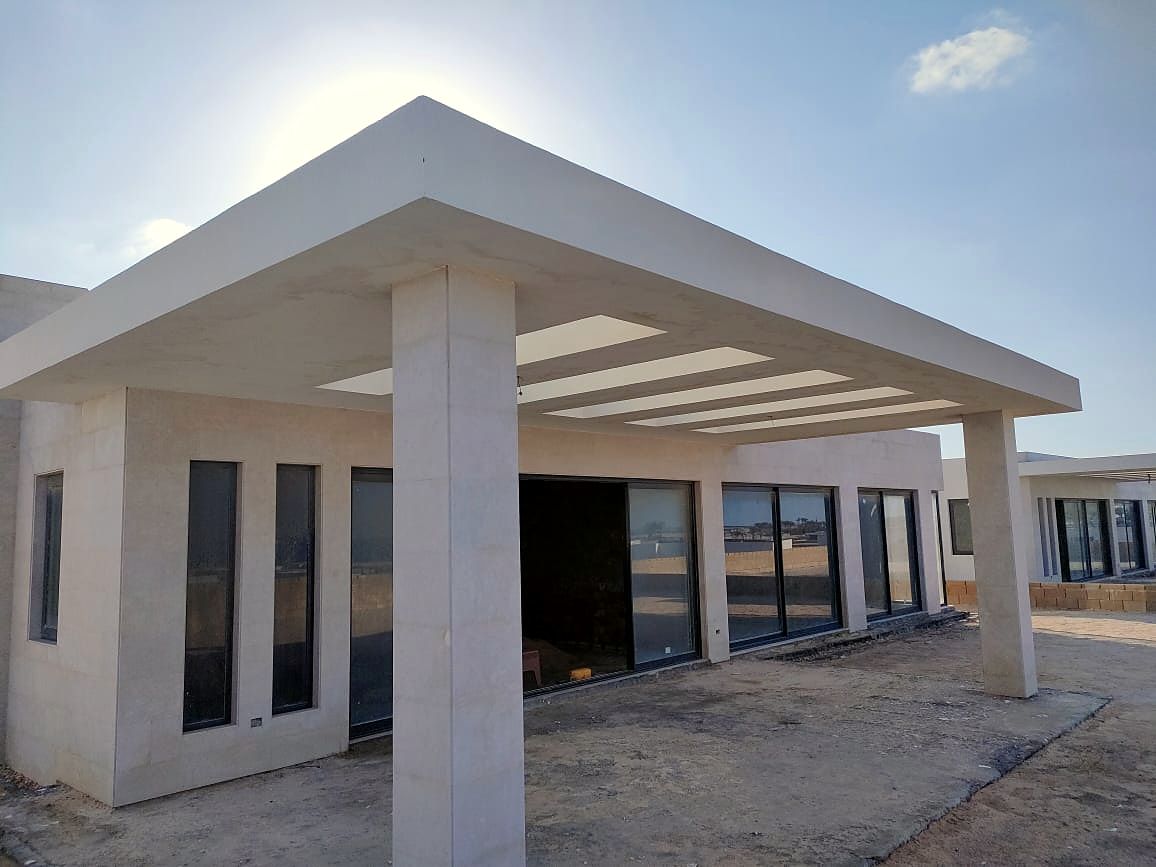
Build From Land
Most people who buy a plot in Egypt become their own main contractor by accident — a mason through a cousin, a plumber who comes when he can, a carpenter who turns up after the tiles are already down, and fifteen invoices nobody reconciles.
See more